
A documentary
Edited on my return, from the footage of the trip. The long format, the one that takes its time.
Four months. A converted van. Seven countries crossed, from Savoie to Guinea. One person alone, and the same questions asked everywhere.
The idea turned up in October 2025. By January 2026 it had become a certainty, to the point that I chose my studies around the possibility of taking a gap year. I sat my final school exams six months later.
Three things came together, and none of the three was enough on its own.
A taste for how other people live. We live inside a system that only ever talks about our own problems, and never goes to see how it works somewhere else, to find out how we might move forward. That imbalance has bothered me for a long time.
Some practice at interviewing, which started at my school web TV. That is where I learnt that a good question is not written in advance, but that you still have to have written it to be able to depart from it.
A pull towards travel and life on the road, in Africa in particular, for how many communities and cultures sit side by side there. And the wish, freely admitted, to live something before going back to studying.
“What I understand is that I understand nothing”
Flavio WTranslated from the French
Which ways of living allow a relationship to the living world that our own societies have lost, and what, in those ways of living, travels to somewhere else?
I think there is, in the most developed countries, a disconnection from the living world. Not an opinion: something you can see by looking at what we eat, what we throw away, and how much time we spend outdoors. Going to see how certain communities hold on to that connection means looking for which ways of living let us live with the living world, over time, in trust.
And behind that sits a simpler conviction: to move towards a world that lasts, you first have to be aware that it is possible. As long as we believe the world of tomorrow is something done to us, we change nothing. Showing that other ways of living work takes that argument away.
The second aim is less respectable, so I may as well write it down: not to leave the wide view to a small elite. The right to look at how the world organises itself should not depend on having gone to the right schools.
I am not setting off with a thesis to prove. I am setting off with a question, and the intention of changing my mind about at least three things I hold dear. A four-month trip that confirms everything you already thought has produced nothing.
Most reporting arrives with cameras, a team, interpreters. Here, one person on their own. What people say to one person alone is not what they say to a film crew: it is not a question of discretion, it is a question of who holds the power. Travelling light is not a small budget dressed up as a principle. It is what makes people talk to me.
Arrive and ask for nothing. Introduce yourself, say why you are there, listen. Two or three days without taking out a single piece of equipment. Only then explain what happens to the recordings, where they will be shown, and what will not be done with them. Recording comes third. Taking out a microphone on day one closes doors that do not open again.
Nine broad questions, asked in every community. The same ones everywhere. Not as an interrogation: they come up out of order, in conversation, and mostly serve to check that I have left nothing out. Without that common ground, you bring back anecdotes instead of groundwork. With it, the answers can be set side by side from one place to the next, and that is where something becomes readable.
Edited on my return, from the footage of the trip. The long format, the one that takes its time.
Here, on this site. Long pieces, a road journal, a gallery. What social media does not allow.
On social media, before, during and after. The day to day, including the days when nothing moves.
Transcribed, indexed, comparable. It will be the raw material for the sociology and ethnology that follow.
A working line, not a schedule. It will move: the zones the French foreign ministry rates orange or red are out, and that rating changes every month.
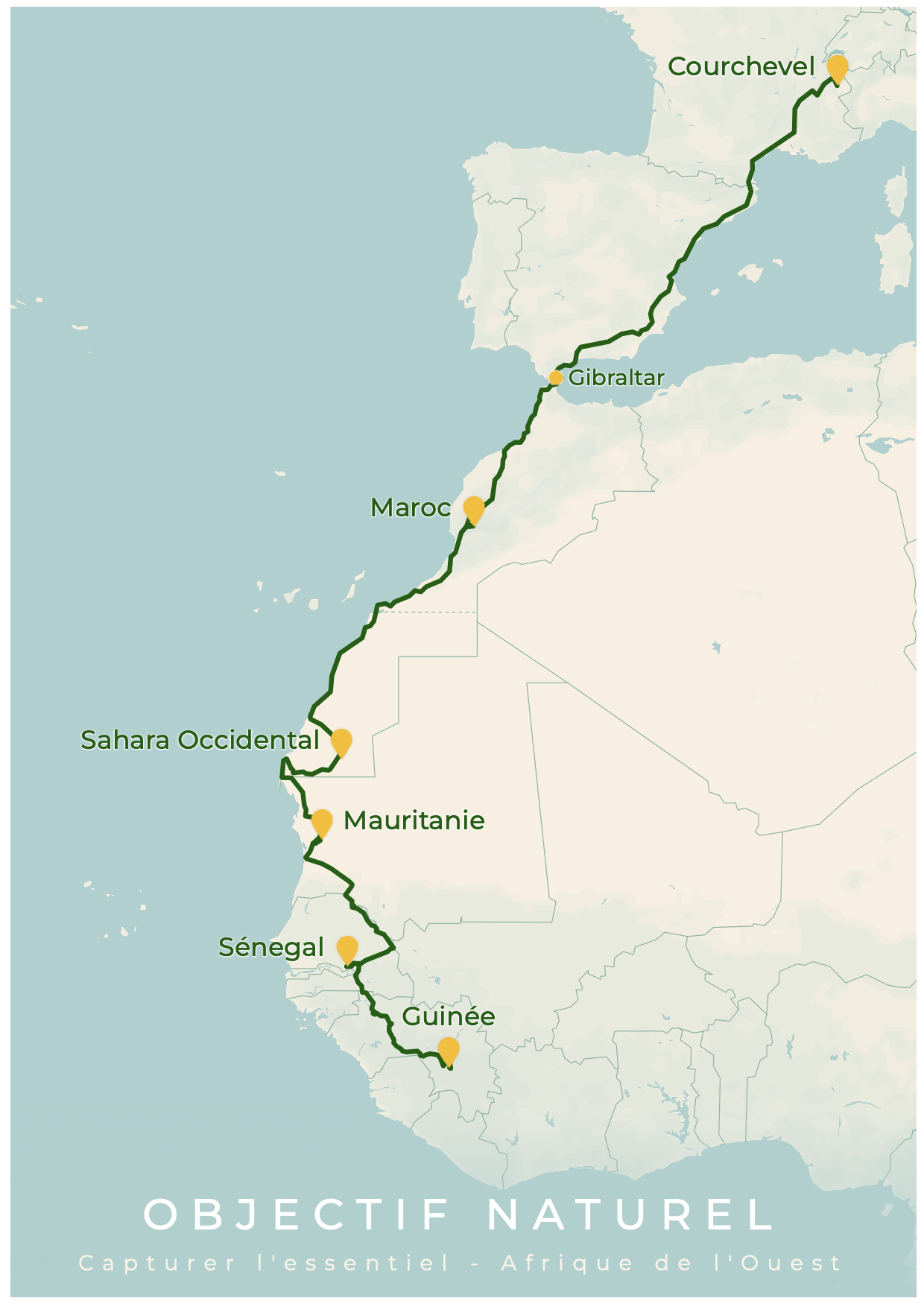
5 January 2027. South through Spain, then Gibraltar.
Arriving on the continent. First bearings, first attempts at the method.
The main point of concern on the trip: the border south of Western Sahara.
The greatest density of communities. This is where the stay will be longest.
An enclave, another language, another relationship to the land, a few kilometres apart.
To be confirmed, depending on the safety ratings and the state of the van.
The furthest south I plan to go. The number of countries is not a goal: if time runs short, I stop earlier.
Red lines are written before they are tested. The day a sponsor puts money on the table, it is too late to work out where they are. So they are written here, in public, and they bind me.
The test. Before signing anything, I ask myself: could I describe this, without squirming, to the people I am going to film? If the answer hesitates, it is a red line.
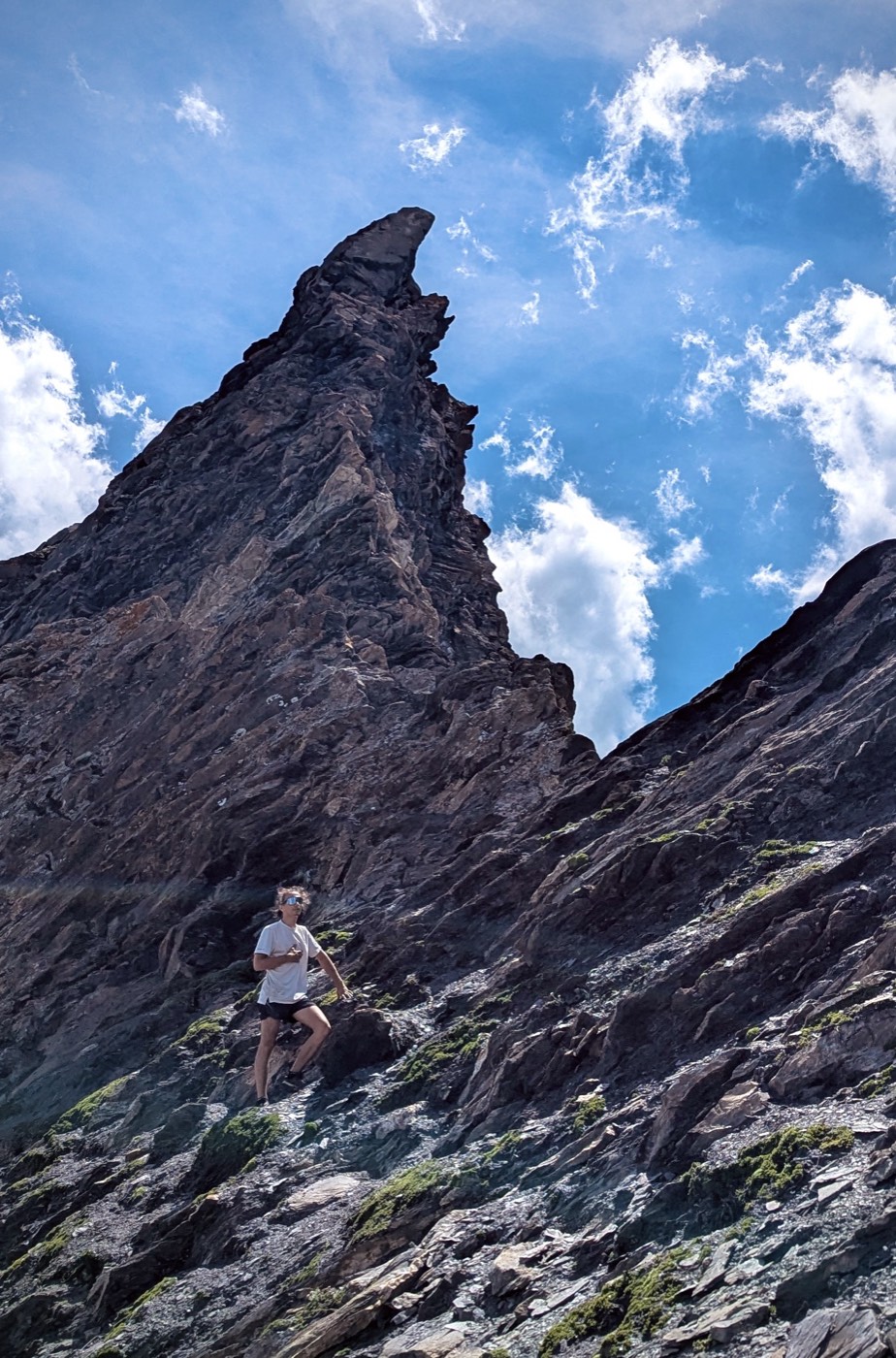
My name is Flavio, I am 18 and I want to see things differently. I have always worked hard and done a lot of sport, and that is no longer enough to feel like I am living, so before I start working life I am going away to learn differently.
The school web TV was a bridge between several of those interests and really opened the way towards interviews and the work of a journalist.
“To change things, I first have to accept them, and accepting them means gathering the knowledge of the system I want to turn around. So without ever being able to understand it, I accept it in order to disown it better.”
Flavio WTranslated from the French
The project is run by a French non-profit association, Objectif Naturel, registered in August 2026. It exists so that the project does not depend on me alone, and so that money coming in can be traced.